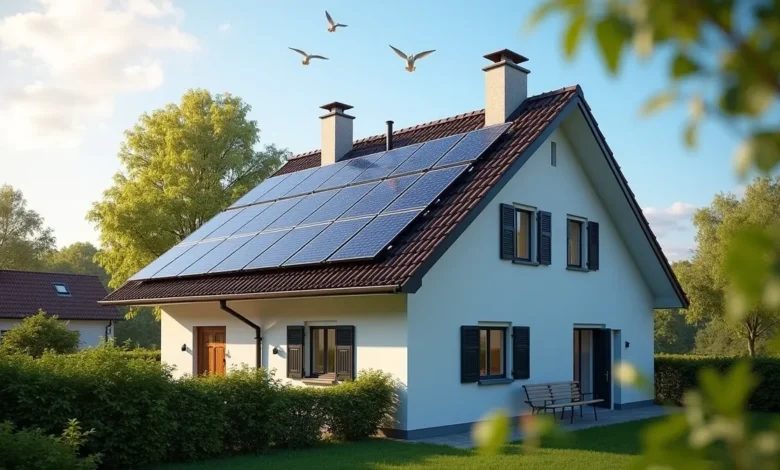
Imagine your rooftop, quiet and still. Now imagine it making money. Or at least, saving a fortune. That’s the silent promise of a solar power system for the home. It’s not magic. It’s physics. And companies like HMS Photovoltaik have turned this science into a quiet revolution for roofs everywhere. It isn’t about far-off futures. It’s about your next electricity bill.
HMS Photovoltaik operates in the vibrant space of solar energy. They focus on turning sunlight into usable power. Their domain is the solar photovoltaic system. It is a complete ecosystem. It starts with photovoltaic solar panels on your roof. These panels capture pure sunlight.


The energy then journeys through solar inverter technology. This clever box converts it into power that your fridge, lights, and TV can use. For times when the sun sleeps, solar energy storage systems hold the bounty. The result? A grid-connected solar system that slashes your costs.
Or a fully independent off-grid solar solution. It is the core of their work. It applies to solar power systems for homes and massive commercial solar energy systems.
Their expertise covers the entire spectrum, from a simple rooftop solar installation to complex industrial solar power systems. This article will pull back the curtain on how it all works.
All Types of Solar Panels + Key Specifications (HMS Photovoltaik System Context)
The tables below list the common solar panel types used in PV systems and the specification ranges you’ll see in real products. Values vary by manufacturer, model, and market.
Table-first • Clean layout • No copied text| Panel Type | Cell / Material | Typical Module Power | Typical Module Efficiency | Temperature Coefficient (Pmax) | Strengths | Best Fit |
|---|---|---|---|---|---|---|
| Monocrystalline (Mono) | Single-crystal silicon cells | 370–700W (most residential 370–460W) | 19%–23% | -0.29% to -0.40% / °C | High efficiency, strong performance in limited roof space | Homes, small commercial rooftops, premium installs |
| Polycrystalline (Poly) | Multi-crystal silicon cells | 250–370W (less common in newer installs) | 15%–18% | -0.33% to -0.45% / °C | Often lower cost, stable technology | Budget-focused systems (where available) |
| Thin-Film (General) | Ultra-thin semiconductor layers | 80–250W (per module, varies widely) | 10%–16% | -0.20% to -0.35% / °C | Handles heat better, flexible options, good low-light behavior | Large surfaces, special structures, niche projects |
| CIGS Thin-Film | Copper indium gallium selenide | 100–220W | 12%–18% (some premium higher) | -0.20% to -0.33% / °C | Good shade tolerance, strong energy yield in varied light | Complex roofs, partial shading scenarios |
| CdTe Thin-Film | Cadmium telluride | 350–550W (often utility-scale formats) | 16%–19% | -0.20% to -0.30% / °C | Strong performance in heat, good large-scale economics | Utility-scale ground mounts |
| Bifacial Mono | Mono cells capturing front + rear light | 450–750W | 19%–23% (front-side rating) | -0.29% to -0.40% / °C | Extra gain from rear-side reflection (albedo) | Ground mounts, carports, bright surfaces |
| PERC / TOPCon / HJT (Mono) | High-efficiency mono cell architectures | 400–720W | 20%–24% (model dependent) | -0.25% to -0.38% / °C | Higher output per m², strong real-world yield | Premium rooftops, performance-first builds |
| Flexible Panels | Thin-film or flexible mono laminates | 50–200W | 8%–18% | -0.20% to -0.45% / °C | Lightweight, bends to curved surfaces | RVs, boats, curved roofs, portable power |
| Building-Integrated PV (BIPV) | PV integrated into roof/glass materials | Varies by product (often lower vs standard modules) | 8%–20% | -0.25% to -0.45% / °C | Combines building material + generation | Architectural projects, premium builds |
Specification Quick Cards (What the Numbers Mean)
Power (W)
The rated output under standard test conditions. Higher wattage usually means fewer panels for the same system size.
Efficiency (%)
How much sunlight becomes electricity. Higher efficiency is useful when roof space is limited.
Temperature Coefficient
Shows how much power drops when panels heat up. A smaller negative number means better hot-weather performance.
Use-Case Fit
Matches panel type to the job: rooftops, ground mounts, shading conditions, portability, or architectural needs.
The Engine Room: Solar Tech Demystified
Let’s get technical. But without the headache. A solar photovoltaic system is a team of components. Each has a critical job. The stars are the photovoltaic solar panels. They’re the face of the operation. You see them on rooftops, in fields, on warehouse tops.
Inside those sleek frames, silicon cells do the hard work. Photons from sunlight hit them and knock electrons loose. It creates direct current (DC) electricity. It’s raw power.
But your home runs on alternating current (AC). It is where solar inverter technology becomes the unsung hero. It’s the brain and the translator. It takes that DC power and flips it into perfect, clean AC. Modern inverters are smart. They maximize every watt of sunshine.
They talk to the grid. They monitor performance. A good inverter is like a masterful conductor for your personal power orchestra.
Then there’s the game-changer: solar energy storage systems. Think giant home batteries. For years, the big solar puzzle was this: the sun shines when you’re at work. Your peak use is at night. Batteries solve that. They store your daytime surplus.
You use it in the evening. It is conversion optimization at its best. It turns a solar setup from a helper into a powerhouse. It’s the key to true energy independence.
- Panel Efficiency: Not all panels are equal. Premium ones squeeze more power from the same sunlight.
- Microinverters vs. String Inverters: One inverter for all panels, or a tiny one on each panel? The choice affects shade handling and long-tail performance.
- Battery Chemistry: Lithium-ion dominates. It’s about cycle life, depth of discharge, and safety.
I once saw a rooftop solar installation on a heritage home in Edinburgh. The challenge? A patchwork of shadows from chimneys and trees. They used microinverters. The result? Even with partial shade, the system’s overall yield was stellar. It was a lesson in smart component selection. Don’t just buy hardware. Buy a solution.
Your Home, Your Power Plant: Residential Solar Solutions
It is where it gets personal. A solar power system for the home is the ultimate DIY project, but you don’t actually do it yourself. You get experts like HMS Photovoltaik to handle it. Why? Because your home is your castle. And its roof is your most valuable real estate.
The journey starts with an assessment. Not every roof is perfect. South-facing? Great. Cluttered with vents and skylights? We can work with that. The installers will map it out. They’ll calculate how many solar panels for homes can fit. They’ll model your annual energy use. The goal is to match your consumption. You want to produce what you eat.
The installation itself is a spectacle of precision. It’s not reckless. It’s careful.
- Scaffolding goes up.
- Roof anchors are secured without compromising weatherproofing.
- Racking is installed—the aluminum skeleton that holds the panels.
- Panels are clicked into place, wired in series or parallel.
- The inverter is mounted, often near your main fuse box.
- The final connection is made.
Then, the magic moment. The system is switched on. Your meter slows. It might even spin backwards. The user intent here is clear: control, savings, sustainability. It’s brand storytelling written in kilowatt-hours. Your neighbor sees your panels. That’s social proof. It’s more powerful than any advert.
A painful flop, I recall? A homeowner cheaped out on the installer—no real site survey. The crew showed up and realized the roof structure couldn’t take the weight. Project cancelled. Lost deposit. Wasted time. The lesson: your installer’s expertise is the most critical component. Don’t just shop for price. Shop for trust.
Powering Commerce: Solar for Business and Industry
The math gets even more compelling at scale. For a business, electricity is a major, volatile cost. Solar energy for businesses flips this from an expense into an asset. We’re talking about commercial solar installations on a whole different level.
Think about a warehouse. Vast, flat, empty roof space. Baking in the sun all day. It’s wasted capital. Slap a commercial solar energy system on it. Now, that roof is generating power for the forklifts, the lights, and the cooling. It’s cutting operational costs every single day. That’s a competitive advantage.
For industrial solar power systems, the impact is massive. Manufacturing is energy-hungry. A rooftop solar setup for factories can cover a significant portion of their base load. It provides price certainty for decades. It’s a hedge against energy market chaos. It also screams corporate responsibility. That matters to clients and investors today.
HMS Photovoltaik would approach this with a different toolkit. The hardware is heavier-duty. The financing models are more complex. Power Purchase Agreements (PPAs) are common. The business doesn’t pay for the system upfront. They pay for the cheaper solar power it produces. It’s a no-brainer for many.
I visited a biscuit factory in Leipzig with a massive system. The project manager told me a quirky win. Their solar output data became a source of pride for the floor staff. They’d check the daily yield screen more than the production line stats.
It created an unexpected sense of collective achievement. Green energy became part of the company culture. That’s emotional resonance no boardroom presentation could plan.
Beyond the Basics: The Real-World Quirks of Solar Life
Theory is clean. Reality is gritty. Let’s talk about what they don’t put in the glossy brochure. Pigeons. They love the cozy space under solar panels for homes. They nest. They leave debris. It can affect performance. The solution? Simple mesh bird guards. Installed during the rooftop solar installation. A tiny detail with a big impact.
Then there’s dirt. Pollen, dust, soot. They form a film on your photovoltaic solar panels. A good rain cleans most of it. But in dry, dusty areas, occasional cleaning is needed. Not with abrasive brushes. Just water and a soft tool. It’s maintenance, but it’s simple.
The grid connection is another piece. A grid-connected solar system is a two-way street. You pull power when you need it. You push excess back when you don’t. Your meter needs to be compatible with this “net metering.” Your utility company has to agree.
A good installer handles all this paperwork. It’s the unglamorous backend work that makes the system legal and safe.
And what about hail? Modern panels are tested to withstand golf ball-sized hail. They’re tough. The real vulnerability isn’t the panels. It’s the wiring and connectivity over 25 years. That’s why quality installation is non-negotiable.
- Monitoring: Your system has an app. You can watch your power flow in real time. It’s oddly addictive.
- Warranties: Panel performance warranties (often 25 years). Inverter warranties (10-12 years). Installer artistry warranties. Read them.
- The Duck Curve: This is an industry insider term. As solar floods the grid during midday, net demand plunges, then spikes at sunset. It’s why solar energy storage systems are critical for the future grid.
The Future is Bright: Where Solar is Heading Next
The technology isn’t standing still. It’s accelerating. Panel efficiency creeps up every year. Solar inverter technology is getting smarter, integrating with home energy managers. But the real frontier is storage and digital integration.
Solar energy storage systems are dropping in price. The next wave isn’t just about backup power. It’s about energy arbitrage. Your system stores cheap solar at noon. You then use it during the expensive peak period at 6 PM. The software does this automatically. It maximizes your financial return.
Then there’s vehicle-to-grid (V2G). Your electric car is a giant battery on wheels. Soon, your solar power system for your home will charge your car. And during a peak, your car could power your home. Or even send juice back to the grid. It turns every EV into a distributed energy asset. It’s a grid revolution parked in your driveway.
For commercial solar installations, the trends are about scale and sophistication. Solar canopies over parking lots. Building-integrated photovoltaics (BIPV), where the panels are integrated into the building façade. AI-driven software that predicts output and optimizes consumption in real time. It is the topical authority zone—where true experts operate.
The painful flop on this frontier? Early adopters who bought proprietary, closed-system batteries. The company went bust. The batteries became expensive, unsupported bricks. The lesson today is to choose storage with open protocols. Standards win.
Google Optimized FAQs
1. How much does a solar power system for a home from HMS Photovoltaik typically cost?
Costs vary wildly by size, location, and equipment. A typical residential system can range from £5,000 to £15,000 after government incentives. The only way to get an accurate price is a site-specific quote that considers your roof, energy use, and goals.
2. Can I go completely off-grid with an HMS Photovoltaik system?
Yes, off-grid solar solutions are possible but require significant investment in batteries and backup generators for long cloudy periods. For most homes connected to the utility grid, a grid-connected system with a battery for backup is a more practical and cost-effective choice.
3. How long does a rooftop solar installation take?
For an average home, the physical installation usually takes 1-3 days. However, the entire process—including surveys, permits, grid approval, and scheduling—can take from 4 to 12 weeks from signing a contract to switch-on.
4. Do solar panels work on cloudy days or in winter?
Yes. Photovoltaic solar panels generate electricity from daylight, not just direct sunlight. Output is lower on cloudy days and in winter due to shorter days and sun angle, but they still produce power. A well-designed system accounts for seasonal variation.
5. What maintenance does a commercial solar energy system need?
Very little. Periodic visual inspections and cleaning (especially in dusty areas) are recommended. Monitoring software alerts you to performance drops. Inverters may need replacement once in the system’s 25+ year life. Most reputable installers offer ongoing maintenance plans.
Sunlight is free. Capturing it isn’t. But the cost of not capturing it is becoming higher every year. HMS Photovoltaik sits at the intersection of this simple truth and complex engineering. Whether it’s solar panels for homes or rooftop solar for factories, the principle is identical.
Turn an idle surface into a productive asset. Create predictability in an unpredictable energy market. It’s a tangible step toward independence. It’s not a slogan. It’s a switch you can flip. The technology is proven. The economics are solid. The question is no longer “if” but “when.” Your roof is waiting. What’s it going to be—a weather barrier, or a power plant?
References:
- International Renewable Energy Agency (IRENA). Renewable Power Generation Costs in 2022.
- BloombergNEF (BNEF). New Energy Outlook and Energy Storage Market Outlook reports.
- National Renewable Energy Laboratory (NREL) PVWatts Calculator for system performance estimation.
- UK Government. Energy Security Bill and Smart Export Guarantee (SEG) tariff information.
- Solar Energy Industries Association (SEIA). Solar Market Insight Report.
Disclaimer: This article is for informational purposes. Technology, costs, and government incentives change rapidly. Always consult with a certified, reputable installer like HMS Photovoltaik for a site-specific assessment and the most current financial analysis before making any investment decision.
Read More Games Related Blog: Knicks vs Kings